
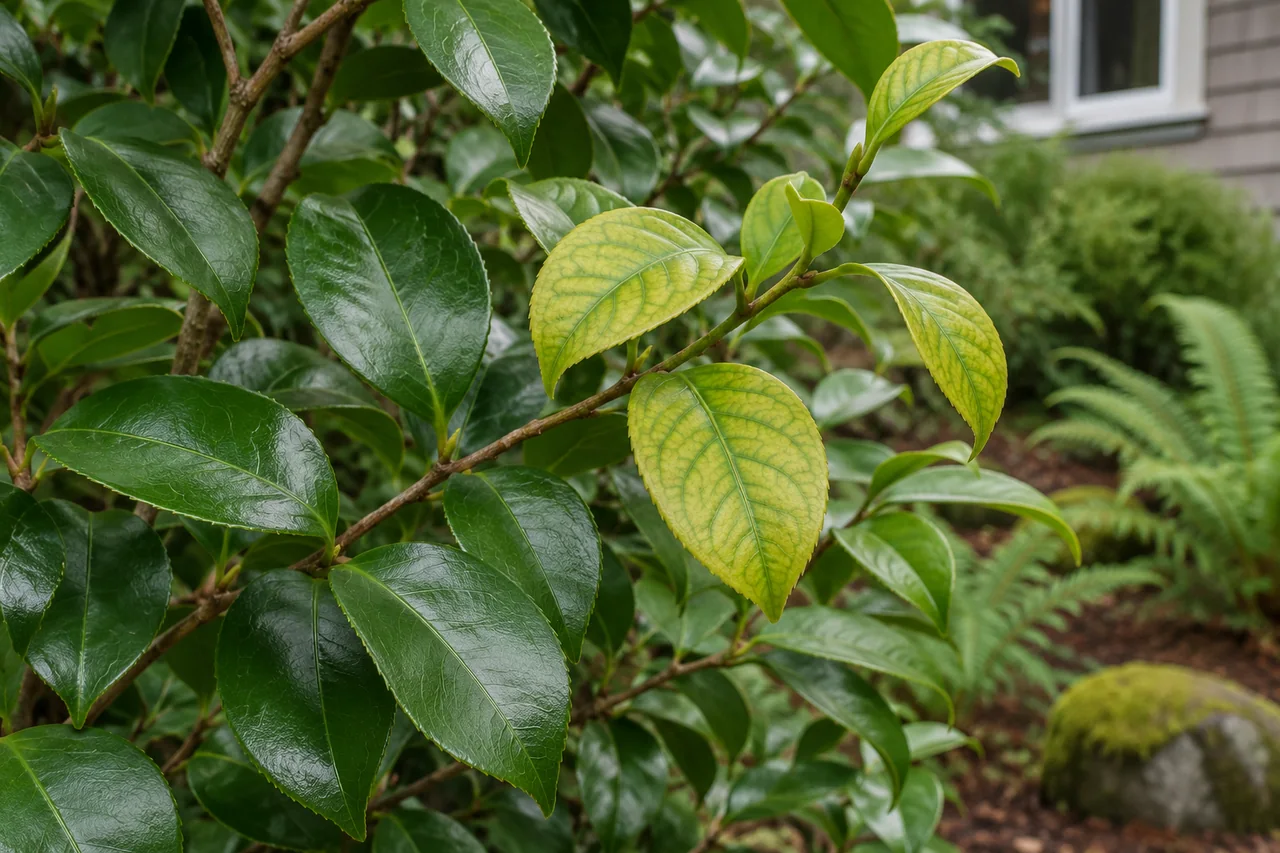
Chlorosis is the loss or reduced development of normal green color in foliage. It describes what the leaf looks like. It does not tell us why it happened.
The quickest route to a poor recommendation is to see yellow and immediately add iron. An advanced assessment follows the pattern from the leaf to the shoot, across the crown, and down into the soil and root environment.
Begin with leaf age
Which leaves changed first is one of the most useful clues. Iron and manganese are relatively immobile within the plant, so problems involving their availability often appear first on younger foliage. Nitrogen, magnesium, phosphorus, and potassium are more mobile, allowing the plant to move some of those nutrients from older leaves toward new growth. Their deficiency patterns may begin on older tissue.
That distinction narrows the question but does not answer it. Damaged roots, cold or saturated soil, vascular disruption, herbicide exposure, disease, and mixed deficiencies can blur the expected pattern.
Look at what remains green
Interveinal chlorosis leaves veins greener than the tissue between them. Uniform chlorosis affects the leaf more evenly. Marginal scorch begins near the edges. Stippling, spotting, mosaic patterns, and distorted growth lead toward different sets of possibilities.
Photograph a full shoot from its growing tip back toward older foliage. That sequence shows how symptoms change with leaf age. One yellow leaf removed from the tree loses most of that context.
The soil may contain the nutrient
A tree can show iron chlorosis even when the soil contains iron. High pH can hold iron in chemical forms that roots cannot use efficiently. Compacted, cold, dry, saturated, diseased, or severed roots may also fail to absorb and transport nutrients that are present.
This is why adding more material is not automatically corrective. A nutrient treatment may improve leaf color while the root-zone condition that caused poor uptake remains unchanged.
Map the pattern beyond one plant
Is the yellowing confined to one branch, one side of the crown, all new growth, or every plant in an irrigated bed? A one-sided pattern can direct attention toward localized root loss, reflected heat, uneven irrigation, vascular injury, or a change in soil. Similar symptoms across several unrelated plants may justify examining shared water, soil, or chemical exposure.
Compare affected and unaffected areas. Concrete, imported fill, old planting beds, grade changes, and different irrigation zones can create meaningful changes in pH and root conditions over a short distance.
Testing should answer a defined question
A soil test can clarify pH, salinity, organic matter, and nutrient context. Foliar analysis can show what reached the leaves. Neither test diagnoses the entire tree, and both depend on correct sampling.
When symptoms are localized, mixing soil from healthy and affected areas can average away the difference. Leaf age, species, season, sampling location, and laboratory reference ranges also affect interpretation. A value marked low is evidence, not automatic proof of the primary cause.
Where advanced treatment fits
A defensible program may use selected nutrients, chelated micronutrients, soil amendments, root-zone applications, or trunk-applied materials. The ingredient and delivery method should match the supported limitation.
For iron, the word chelated is not enough. EDTA, DTPA, and EDDHA hold iron differently as pH rises. Choosing among them requires knowing the soil conditions and treatment objective. Applying micronutrients without evidence can create toxicity or interfere with other elements.
Trunk-applied nutrients can temporarily bypass a difficult root environment, but they do not change soil pH or repair damaged roots. Soil applications may address a broader root area, but their performance depends on placement, chemistry, moisture, and the tree’s ability to take them up.
Our approach connects color with tree function
We do not treat yellow foliage as a request for a generic fertilizer. We look at the leaf pattern, root conditions, soil chemistry, irrigation, species, and recent site history. When treatment is supported, the plan may combine advanced nutrients or soil amendments with changes that improve water, oxygen, and root function.
The goal is not simply to force a quick green color. It is to improve the conditions that allow healthy new foliage to develop and to define how that improvement will be measured.
Judge the response on new growth
Existing yellow leaves may never return to a perfect green. New leaf color, shoot length, leaf size, crown density, and the distribution of symptoms in the next growth cycle usually provide better evidence. Repeat photographs from the same position make subtle changes easier to see.
Rapid wilting, substantial dieback, bark injury, or chlorosis following root disturbance deserves prompt attention because yellowing may be only one sign of a larger vascular or root problem.
Bring the pattern, not just a leaf
Photograph the whole plant, affected and unaffected shoots, new and old foliage together, the trunk base, and the surrounding site. Note irrigation or landscaping changes and whether neighboring plants share the symptom. An appointment can then determine whether testing is likely to change the recommendation and which treatment objective is supported.
References: Washington State University, Plant Problem Diagnosis; Washington State University, Plant Mineral Nutrition and Fertilizers; Washington State University, Soil Science; International Society of Arboriculture, Tree and Shrub Fertilization Best Management Practices.