
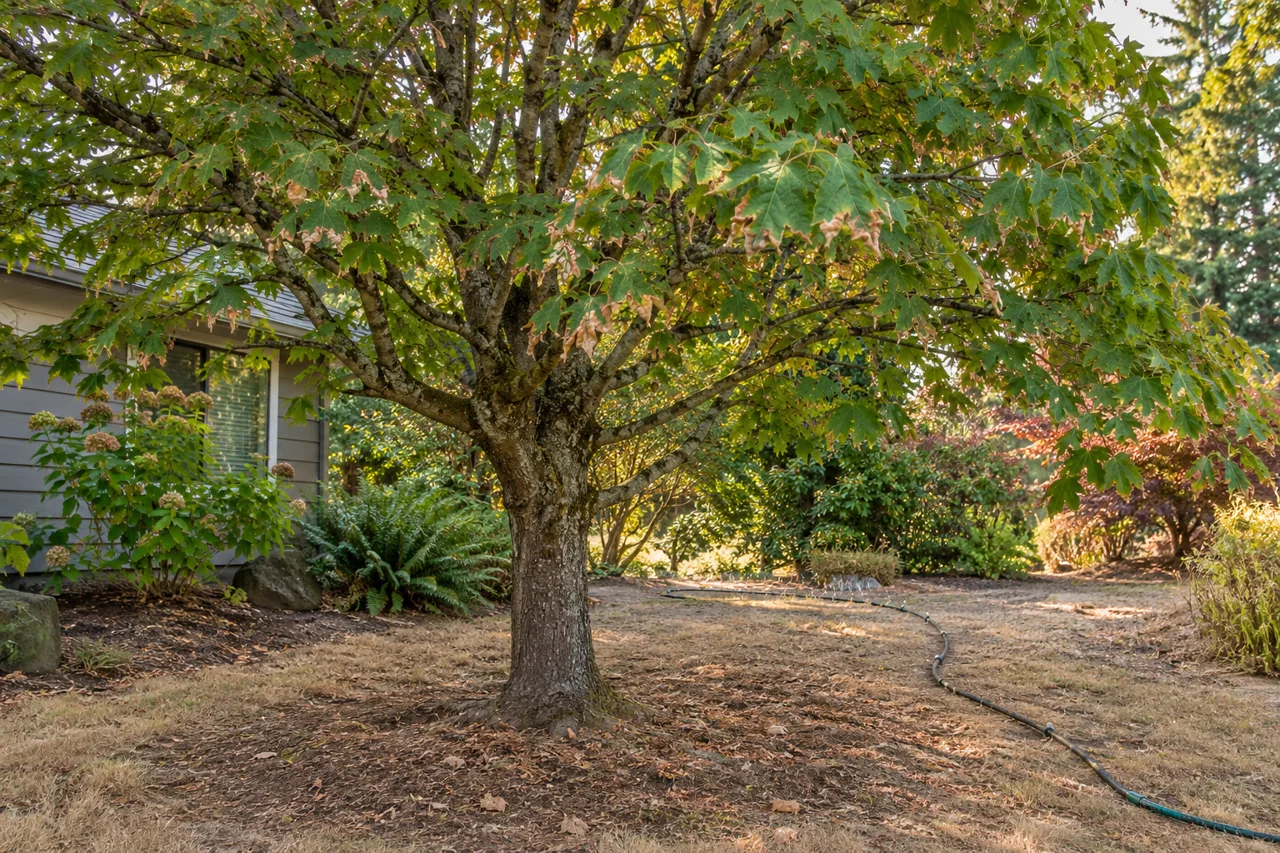
Drought stress rarely begins with a tree turning completely brown. More often, the first change is smaller: shorter shoots, thinner foliage, scorched leaf edges, early color, or a crown that does not look as full as it did a few years ago.
Those changes can be easy to dismiss, especially after rain returns. The tree may survive the dry period while carrying reduced root function, depleted energy reserves, or greater susceptibility to insects and disease into the following seasons.
The tree may be responding before you can see it
When water is limited, a tree closes leaf pores to reduce moisture loss. That also limits photosynthesis, so less energy is available for growth, storage, defense, and repair. Fine absorbing roots may die back in dry soil. If stress continues, the tree may shed leaves or needles and reduce the amount of living crown it must support.
A mature tree can draw on stored resources for a time. That delay is one reason a tree sometimes appears to decline suddenly after several dry summers. The visible change may be the latest stage of a process that began much earlier.
Read the site along with the crown
Wilting, scorch, yellowing, thinning, early leaf drop, and dieback are not exclusive to drought. Saturated soil, damaged roots, vascular disease, reflected heat, and insects can create similar symptoms. The surrounding site helps make sense of what you see.
Ask what changed. Was lawn irrigation reduced? Was a neighboring tree removed, exposing the crown and soil to more sun and wind? Did paving, trenching, grading, or construction affect roots? Does water run away from the slope or collect in a low area? A dry-looking crown does not always mean the correct response is simply more water.
New trees and established trees use different soil volumes
A recently planted tree still depends heavily on the original root ball. The surrounding soil may be damp while the root ball is dry, or the root ball may stay saturated while water drains through the native soil. Check both areas.
An established tree usually has absorbing roots spread far beyond the trunk and often beyond the canopy edge. One emitter at the base cannot represent that whole area. Turf sprinklers may wet the surface frequently without delivering meaningful moisture through enough of the tree’s root zone.
Measure moisture instead of watering by habit
Check below the surface at several locations. Water should enter slowly enough to soak in rather than run toward pavement. The useful interval depends on soil texture, drainage, weather, rooting depth, species, tree size, and the area being treated. A fixed number of minutes cannot account for those differences.
The goal is adequate moisture followed by aeration. Roots need oxygen as well as water. Constant saturation can damage roots and produce a wilted or thin crown that looks deceptively similar to drought.
Drought and bark beetles are connected
Conifers use resin and other defenses against bark beetles. Water stress can reduce those defenses and create more vulnerable hosts. When many trees are stressed across an area, beetle populations have more opportunities to reproduce. High beetle pressure can then threaten trees that might otherwise resist attack.
Watch drought-stressed conifers for fresh boring material, new pitch, focused woodpecker activity, and unusual crown fading. Treating a beetle without addressing water and root conditions leaves the underlying stress in place. Water and soil care alone may also be insufficient when significant beetle pressure is already present.
Why soil support is part of treatment
Mulch, irrigation correction, protection from compaction, and site-specific soil amendments can improve the conditions around absorbing roots. Advanced programs may also use ingredients intended to improve water movement, nutrient availability, or other root-zone functions. Each component should have a defined purpose.
Well-matched root-zone care can improve moisture movement, nutrient availability, and the growing conditions around absorbing roots. Our approach pairs that support with irrigation and drainage corrections that address the actual site. When bark-beetle protection is also needed, injection addresses the insect within the tree while root-zone work supports water movement, new growth, and the tree’s natural defenses.
Recovery is judged on what happens next
Leaves that were already scorched may not become green again. Dead branches do not recover. Better signs include healthy buds, improved new growth, stable crown density, reduced progression of dieback, and soil moisture that becomes more consistent through the root area.
That response may take more than one growing season. A useful plan records the starting condition and defines what will be checked later instead of escalating products because the tree did not change immediately.
When an appointment is worthwhile
Have the tree assessed when crown thinning is progressing, branches are dying, boring material or pitch appears, irrigation results are uncertain, roots were recently disturbed, or several plants are declining together. An appointment can separate drought from drainage or root disease, measure what the irrigation is actually doing, and determine whether the tree would benefit from soil support, pest protection, or both.
References: Oregon State University Extension, How Drought Stress Affects Landscape Trees; Oregon State University Extension, Conserving Water in Your Yard and Garden; USDA Forest Service, Field Guide to Common Diseases and Insect Pests of Oregon and Washington Conifers; USDA Forest Service research on drought stress and bark-beetle vulnerability.