You do not need to diagnose the tree before asking for help. “The leaves look different,” “one side is getting thin,” or “this tree has not looked right since the landscaping changed” is enough to begin.
A tree-health appointment is a conversation followed by an investigation. The goal is to understand what you have noticed, what matters to you, and what the tree and its growing site are showing.
We start with your concern
You may want to preserve a valuable tree, understand a new symptom, decide whether treatment is worthwhile, plan work near roots, or know whether a tree can reasonably recover. Those are different objectives, and they lead to different questions.
Past photographs, irrigation changes, pruning dates, construction, storms, and previous treatments can be helpful. Exact records are welcome but not required. A rough timeline is often enough to reveal which changes came before the symptoms.
The whole setting matters
A tree does not live separately from the property. Pavement can reflect heat. A downspout can keep roots saturated. Lawn removal can take away water a mature tree had used for years. Trenching, grade changes, compaction, and neighboring tree removal can affect roots or exposure.
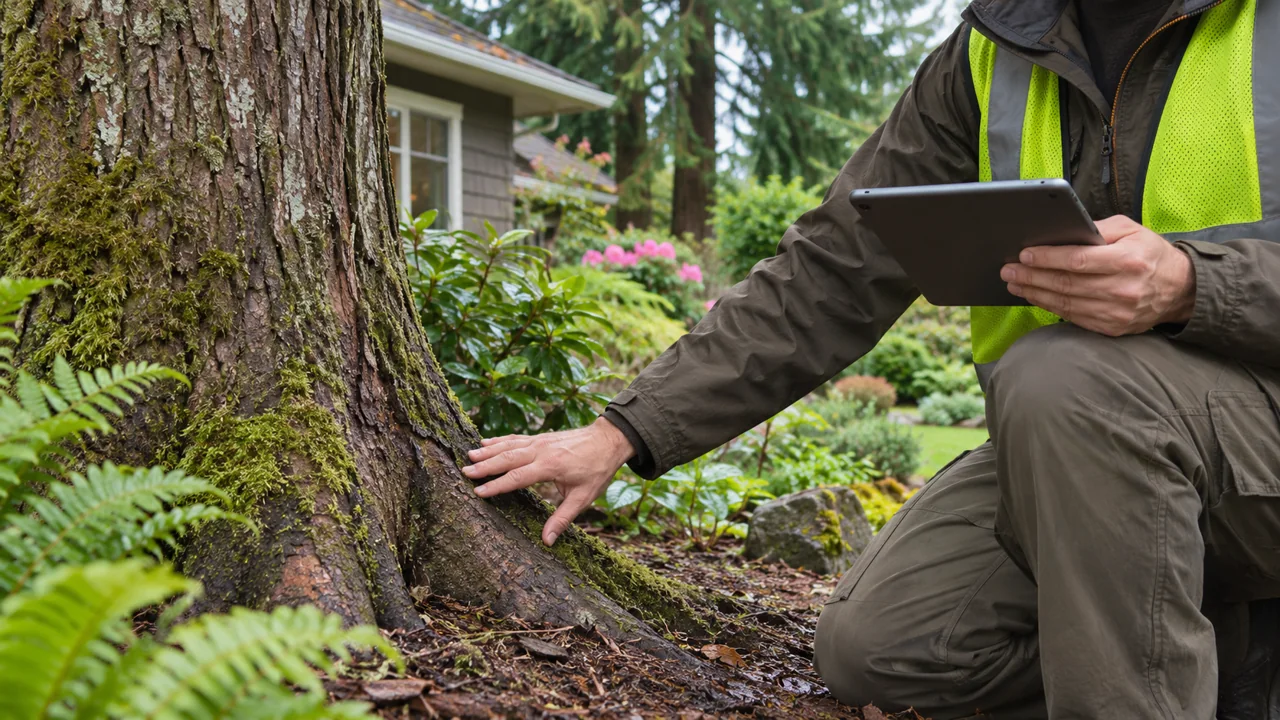
The inspection therefore includes more than the damaged leaf or branch. Crown density, shoot growth, foliage pattern, deadwood, branch structure, bark, trunk flare, visible roots, mulch, soil, irrigation, drainage, and nearby plants can all contribute evidence.
Symptoms are organized into possibilities
Yellow leaves, sap flow, dieback, small growth, holes, and bark changes are symptoms. Several causes can produce the same visible result. The useful work is to compare the pattern with the tree species, site, timing, weather, and history.
Sometimes the evidence supports a practical recommendation during the visit. Other situations benefit from soil or tissue testing, laboratory diagnosis, irrigation measurement, monitoring, or a more focused structural assessment. Testing should answer a defined question rather than produce numbers without a decision attached.
The recommendation should fit the evidence
The next step may involve pruning, irrigation correction, soil amendments, root-zone protection, insect or disease treatment, monitoring, or no immediate work. More than one option may be reasonable. Expected benefit, timing, limitations, tree value, and the likelihood of response all belong in the discussion.
Our tree-health programs often combine tools. An injected active ingredient may address a pest inside the tree while soil amendments and root-zone care support water uptake, nutrient availability, and natural defenses. Each part should have a clear purpose.
What you should leave with
A productive visit should make the next decision clearer. You should understand what was observed, what explanation is best supported, what remains uncertain, and which action is proportionate to the concern.
If treatment is recommended, the objective and review point should be clear. If monitoring is the better choice, you should know what change to photograph or report. If no action is needed, that is also a useful result.
How to prepare
- Make the tree and surrounding area accessible.
- Point out the exact symptom or view that concerns you.
- Share recent changes in irrigation, landscaping, digging, storms, or pruning.
- Explain what outcome matters most to you.
You can request an appointment with nothing more than a description of what looks different. The purpose of the visit is to turn that observation into a useful plan.
References: Washington State University, Plant Health Care and Integrated Pest Management; International Society of Arboriculture, Plant Health Care Best Management Practices.