
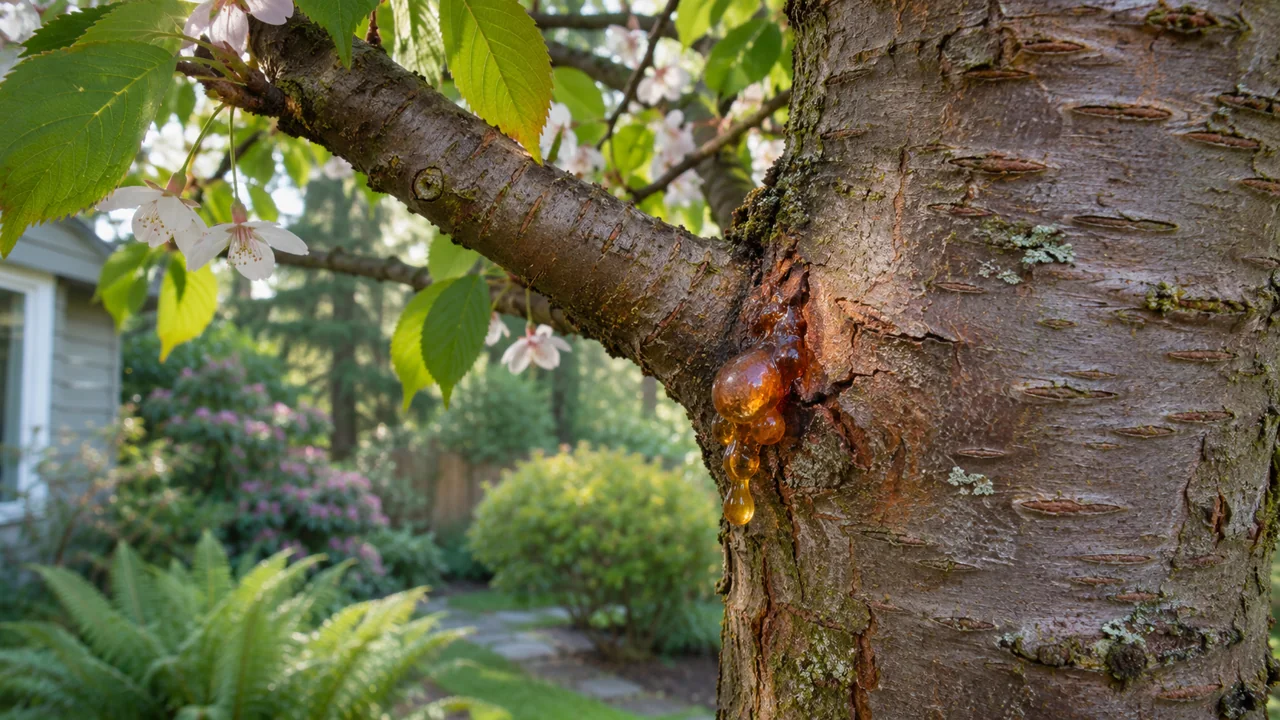
Amber gum on a cherry tree is hard to ignore. It may appear as a clear bead, a sticky streak, or a dark mass that has collected bark and debris. The gum tells us the tree is responding to injury or stress. It does not identify the cause by itself.
That distinction matters because cherries can produce gum after physical injury, winter damage, bacterial canker, fungal disease, insect activity, excessive growth, or unfavorable soil and water conditions. Treating the gum without understanding the surrounding pattern can miss the real problem.
Begin with the location
Find the point where the gum first leaves the bark. Is it on a small twig, at a pruning cut, around an impact wound, on a major branch, or on the trunk? Does the bark around it look normal, or is it sunken, cracked, darkened, loose, or dead?
Then follow the branch in both directions. Check the foliage and buds beyond the gummy area. Look for wilt, shoot dieback, blossom injury, dead leaves that remain attached, or a canker that crosses a branch union. A small wound on one twig is a different situation from an expanding lesion on the trunk.
Common explanations
Mechanical or weather injury
Pruning cuts, staking ties, mower or string-trimmer impacts, rubbing branches, sun injury, and winter damage can all lead to gumming. The shape of the wound and the timing of the event may make this explanation more likely.
Bacterial or fungal cankers
Bacterial canker caused by Pseudomonas syringae is an important problem in cherries. Cankers may be sunken or discolored, and buds, shoots, blossoms, or branches beyond the affected tissue may die. Several fungi can also cause cankers or contribute to gumming. Gum alone cannot distinguish among them.
Insects
Borers and other insects may be associated with gum, holes, frass, or damaged bark. Look for boring material, distinct holes, bark disruption, or repeated activity in a particular part of the tree. Do not assume that every gummy spot needs an insecticide.
Water, roots, and growth conditions
Wet or otherwise unfavorable sites can predispose cherries to gumming and disease. Excessive water or nitrogen may encourage soft growth that is harder for the tree to support. Drought, buried root flares, compaction, and root injury can add stress from the other direction.
What not to do
Do not carve into the trunk to drain the gum, coat it with a household sealant, or apply fertilizer simply because the tree looks stressed. Those actions can create more injury, hide useful evidence, or worsen an existing imbalance.
Do not choose a pesticide by the appearance of the gum. A fungicidal active ingredient will not control a bacterial canker. An insecticidal ingredient will not correct saturated soil or winter injury.
How the site helps explain the symptom
Check whether irrigation wets the lower trunk, whether the root flare is visible, and whether water collects in the planting area. Note recent pruning, cold events, impacts, grade changes, and heavy fertilizer applications. The tree’s species, cultivar, and rootstock can also influence susceptibility.
When an infectious canker is suspected, season and weather matter. Laboratory testing may help in selected cases, but organisms are not recovered equally from every tissue or at every time. A useful sample and a clear question are more valuable than testing gum by itself.
Treatment follows the cause
A sound plan may involve correcting irrigation, protecting the trunk, removing appropriately located dead or infected tissue, managing a confirmed insect, addressing root-zone stress, or monitoring a stable wound. The order matters. Treating a possible pathogen while irrigation continues to wet the trunk leaves an important condition unchanged.
Pruning depends on the cause, extent, timing, and availability of a suitable branch union. A large trunk canker cannot be managed like a dead twig. When infectious disease is suspected, tool sanitation and disposal of affected material may also matter.
When the cherry needs a closer look
Request an appointment when gum is increasing, bark is sunken or discolored, branches are dying, foliage wilts on part of the crown, boring material or holes are present, or the affected area reaches the trunk or a major union. Bring a whole-tree photograph and close views that show where the gum begins.
You do not need to identify the cause first. “My cherry is leaking sap” is enough to begin. The useful next step is to connect that symptom with the bark, branch, crown, roots, and site so the response fits the actual problem.
References: Pacific Northwest Plant Disease Management Handbook, Cherry Gumming; International Society of Arboriculture, Insect and Disease Problems; Washington State University, Plant Problem Diagnosis.