
Bark beetles are not new to our forests and landscapes. What has changed is the amount of stress many trees are carrying. Hotter summers, longer dry periods, compacted soil, root loss, and competition for limited water can leave a conifer with fewer resources to defend itself.
That matters because a healthy conifer does not simply stand still when a beetle attacks. It can push resin into the entry point, trapping or forcing out the insect. A drought-stressed tree may produce less resin or respond too slowly. Beetles that would normally concentrate on severely weakened trees can gain a foothold, reproduce, and increase local pressure. When beetle numbers become high, more vigorous trees may also be attacked.
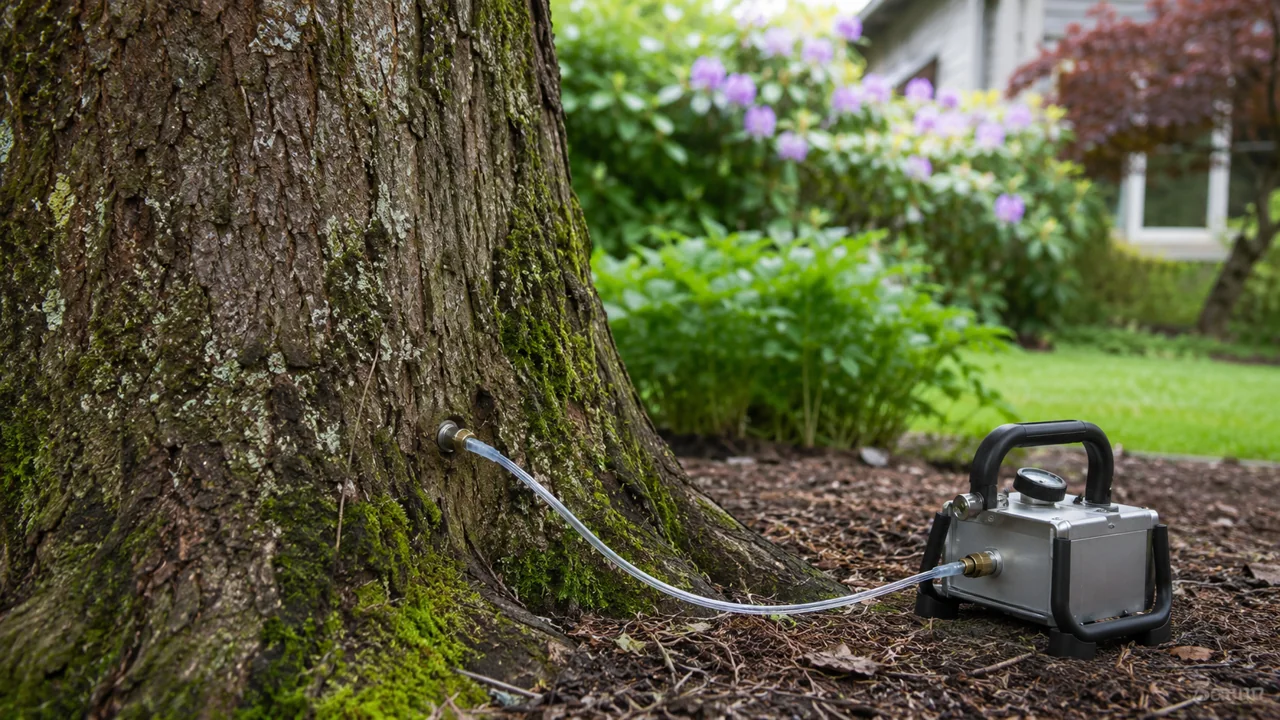
Tree injection is one way to protect selected high-value trees. It places a systemic insecticidal active ingredient into the tree’s vascular system. The tree then distributes that material into tissues where certain beetles feed beneath the bark. For the right tree and target insect, this can provide meaningful protection without coating the entire trunk or broadly treating the surrounding property.
We combine that internal protection with soil amendments and root-zone care chosen for the tree and site. The injection targets beetle pressure. The soil program supports the living system that must move water, produce resin, and recover from stress. Treating both sides of the problem is a more complete approach than asking an insecticide to compensate for poor growing conditions.
Why bark beetles can cause so much damage
Bark beetles spend much of their lives in a protected space between the bark and wood. Adults enter through the bark and create galleries. Larvae feed in the phloem and cambial region, the living tissues responsible for moving sugars and producing new vascular tissue. A successful attack can interrupt the tree’s ability to move water and energy. Associated fungi may add to that disruption in some bark beetle systems.
This hidden feeding is one reason bark beetles are difficult to manage after an attack is well established. The damage is happening inside the trunk, and a fading crown may not become obvious until a large amount of living tissue has already been affected.
How injection can help
A systemic injection works from within the tree. When a susceptible beetle attempts to feed or establish galleries in treated tissue, it encounters the active ingredient. Depending on the beetle species, tree species, ingredient, and timing, that exposure can kill beetles, reduce successful colonization, and protect the vascular tissue they would otherwise damage.
Emamectin benzoate is the most extensively studied systemic active ingredient used to protect western conifers from bark beetles. USDA Forest Service research has documented significant protection in controlled trials, including protection that continued beyond a single flight season in some studies.
One formulation used in our programs is Arborjet TREE-äge R10, a restricted-use product containing 9.7 percent emamectin benzoate. Arborjet TREE-äge G4 is another formulation that has been evaluated in published research. The current TREE-äge R10 federal label includes bark beetles and related borers and provides about two years of control for listed uses. USDA Forest Service studies of TREE-äge formulations found significantly lower tree mortality than in untreated controls.
That gives us a meaningful protection window while we also work on the conditions affecting the tree. Preventive timing allows the active ingredient to move through functioning vascular tissue before beetle damage becomes extensive. Soil amendments, appropriate water management, and root-zone support help the tree maintain the function and natural defenses that treatment depends on.
For suitable candidates, the practical benefits can be significant:
- The treatment reaches protected feeding tissue. Beetles beneath the bark are difficult to contact from the outside.
- Exposure outside the tree is reduced. Injection avoids spray drift and greatly limits material on bark, nearby plants, pavement, and surrounding property.
- Large trees can be protected without spraying the entire trunk. This can be especially useful where access, neighboring property, or the tree’s size makes thorough exterior coverage difficult.
- Some treatments can provide protection beyond a single flight season. The duration depends on the active ingredient, tree, pest, and label.
- The dose is placed directly into the tree. It is not left at the soil surface waiting for root uptake or dependent on uniform spray coverage.
Drought changes the risk
Drought does not create bark beetles, and it does not make every dry tree destined for attack. It changes the balance between the beetle and the tree. Water stress can reduce growth, limit resin production, and weaken other defenses. At the same time, warm conditions may improve survival or development for some beetle species. When many susceptible trees are stressed at once, beetle populations have more opportunities to reproduce.
The relationship is not perfectly linear. Different beetles respond differently to temperature, host moisture, and drought severity. Still, the pattern seen across the Northwest is important: repeated drought and heat can increase the number of vulnerable trees, and bark beetle damage can continue after the driest period has passed.
Watering and root-zone care remain important because insecticide does not correct drought stress. Mulch, appropriate irrigation, protection from root damage, and avoiding unnecessary summer injury help the tree maintain its own defenses. Injection and soil care support different parts of the same goal.
Why we pair injections with soil amendments
An injection can address the insect inside the tree, but the roots still determine whether that tree can take up water and sustain new growth. Urban and residential soils are often compacted, low in organic matter, disturbed by construction, or unevenly irrigated. Those limitations do not disappear when the beetles are controlled.
Our programs pair injection with carefully selected soil amendments and root-zone support. The exact approach depends on the site. It may be intended to improve soil structure, moisture management, nutrient availability, or the biological conditions around absorbing roots. We do not use one generic blend for every property, and soil amendments are not presented as insecticides. Their role is to support the tree while the injected active ingredient directly addresses a researched pest target.
We have used this integrated approach to help protect and preserve more than 25,000 trees. The injection addresses bark-beetle pressure inside the tree, while soil amendments and root-zone care support water uptake, nutrient availability, root function, and the tree’s natural defenses.
Protection works best before the tree is overwhelmed
The strongest use for bark beetle injection is usually preventive protection of a valuable tree that remains capable of moving the material through functional sapwood. It may also be considered when attack pressure is present and evidence suggests treatment can still protect enough living tissue. It is not a way to rebuild phloem that has already been girdled or restore a crown after the vascular system has failed.
This is why early clues matter. Fresh boring dust in bark crevices, new pitch tubes or resin flow, localized bark injury, woodpecker activity, fading foliage, and nearby beetle-killed trees can justify a closer look. None of those signs identifies every beetle by itself. Resin can also result from mechanical injury, disease, or other insects, and old exit holes may only document a previous generation.
The advantage of acting while the tree can still respond
Preventive treatment gives a tree the best opportunity to distribute the active ingredient before beetles have interrupted large portions of its vascular system. It also gives soil and water improvements time to support the tree’s natural defenses. Waiting for the entire crown to fade can remove many of the options that were available earlier.
A good candidate does not need to look sick. A valuable susceptible conifer may deserve protection because nearby trees have been attacked, drought stress has been building, or the site has a history of beetle pressure. Matching the tree, beetle, timing, and active ingredient is what turns injection from a general idea into useful protection.
When you are concerned about bark beetles
If a conifer is producing new pitch, developing boring dust, thinning in the crown, or standing near recently killed trees, it is worth looking at the pattern before assuming the tree is lost. The same is true for a healthy, valuable conifer in an area where beetle losses are increasing. An appointment can help identify the likely beetle, assess how well the tree is still functioning, and build a plan that combines researched internal protection with support for the soil and roots.
References: International Society of Arboriculture, Tree Injection Best Management Practices, Second Edition; USDA Forest Service, Protecting Conifers from Bark Beetles With Insecticides in the Western United States; USDA Forest Service evaluation of Arborjet TREE-äge formulations; Grosman and colleagues, systemic insecticides for protecting western conifers from bark beetle mortality; Arborjet TREE-äge R10 federal label; USDA Forest Service, Field Guide to Common Diseases and Insect Pests of Oregon and Washington Conifers; Kelsey and colleagues, drought stress and tree vulnerability to bark beetle attack.