
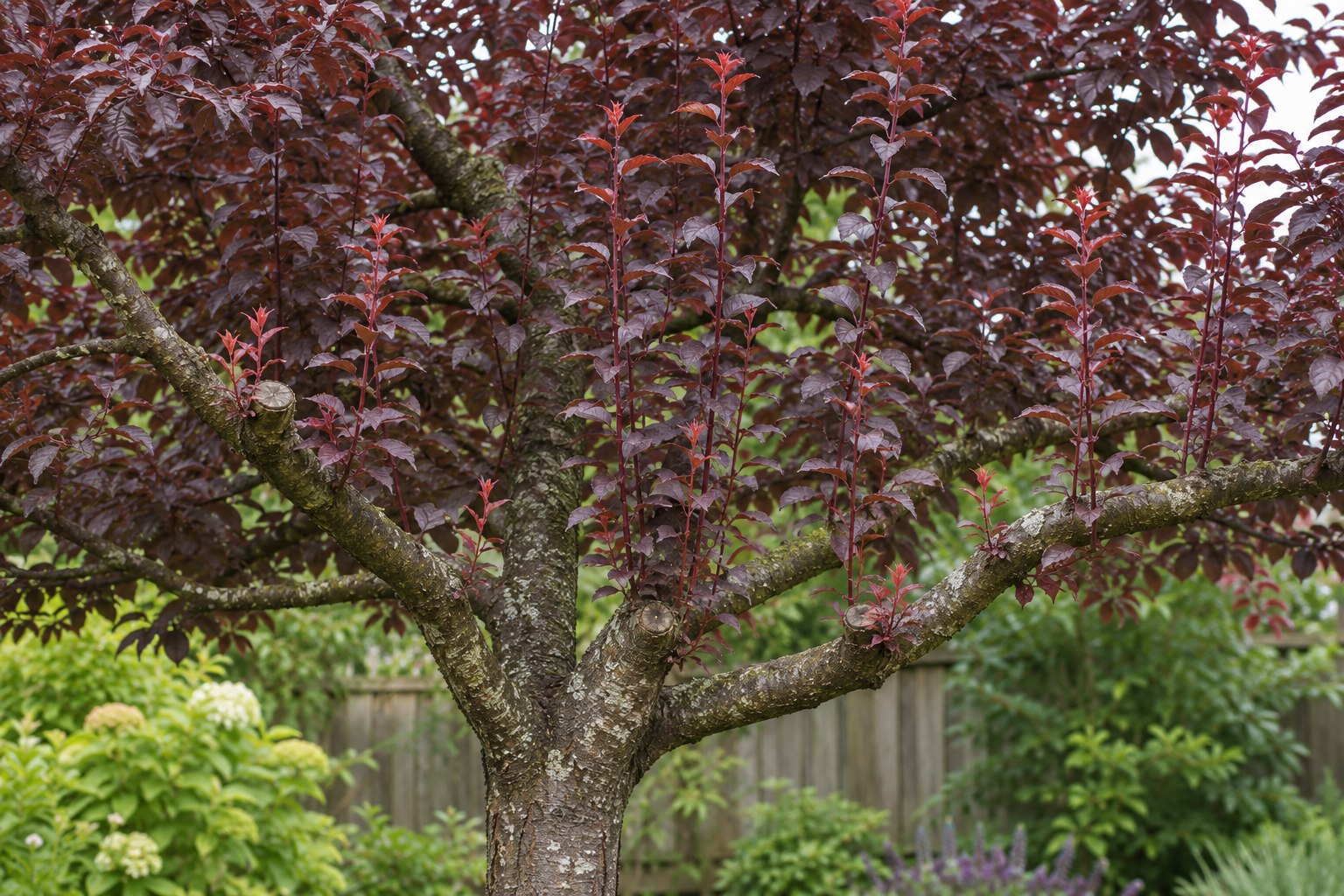
A fruit tree can look neatly pruned in winter and then fill with straight, fast-growing shoots by summer. Those shoots are not proof that the pruning failed. They are part of the tree’s response to lost foliage, strong stored energy, changing light, or stress.
Several kinds of vigorous growth are commonly grouped together, but their starting points matter. A water sprout grows upright from the trunk or an established branch. A sucker begins from a root. A shoot arising from the lower trunk is more accurately described as a basal shoot. All three can grow quickly, yet they may call for different decisions.
Why water sprouts appear
A tree maintains dormant buds beneath its bark. When a limb is shortened hard, a large amount of foliage is removed, or sunlight suddenly reaches wood that used to be shaded, some of those buds may begin growing. The tree is rebuilding leaf area, which it needs to make energy.
This is why aggressive pruning can create the very growth a homeowner hoped to control. A tree cut back severely may answer with a dense cluster of vigorous upright shoots. Repeating the same heavy cuts every year can keep that cycle going and leave crowded growth attached around old wounds.
Water sprouts can also appear after storm damage, root disturbance, drought stress, or a major change around the tree. Their presence alone does not identify the cause. The recent history of the tree usually explains more than the shoots themselves.
Why suckers need a closer look
True suckers arise from the root system. On a grafted fruit or ornamental tree, a sucker or basal shoot from below the graft union may belong to the rootstock rather than the named variety above it. If allowed to grow, that rootstock growth can compete with the desired crown and may eventually dominate part of the tree.
Basal growth may also follow injury, stress, or the removal of a nearby stem. Before cutting, confirm where the shoot begins. A young replacement stem and a rootstock sucker can look similar from a few steps away but have very different value.
Should every upright shoot be removed?
No. The right choice depends on the tree and the objective.
- Remove growth that is clearly competing with the intended structure. Dense shoots growing from one point can crowd each other and shade productive wood.
- Keep useful growth when the tree needs a new branch. A well-positioned shoot can sometimes be retained and trained to fill an open part of the crown.
- Work gradually on an overgrown tree. Removing every vigorous shoot and heavily reducing the crown in one visit can trigger another strong response.
- Protect the branch collar and trunk tissue. Poor cuts can create larger wounds without solving the reason the growth appeared.
On fruit trees, pruning also affects fruiting wood, light distribution, harvest height, and branch strength. Apple, pear, plum, and cherry do not all respond in exactly the same way, and disease concerns can affect timing. A simple rule such as “cut off every vertical shoot” misses those differences.
What a homeowner can notice from the ground
Look at where the shoots originate and what changed before they appeared. Was the tree reduced heavily last year? Did a major limb break? Are the shoots clustered around an old cut? Are they coming from the soil, from below a graft, or from the upper branches? Purple-leaf cherry plums make this response especially easy to see when bright new upright shoots rise through the darker crown. A few photographs taken during leaf-out and again in midsummer can make the pattern much easier to interpret.
It is also fine not to know which shoots matter. The useful question is not simply how to remove them. It is what role, if any, they can play in the future structure and productivity of the tree.
A better goal than making the tree look empty
Good pruning leaves enough foliage for the tree to function, preserves or develops sound branch structure, and makes the fewest useful cuts. For a neglected fruit tree, that often means a staged plan rather than a dramatic one-day correction.
If fast regrowth keeps returning or the tree’s structure is hard to read, you can request an appointment. We can look at what produced the growth and suggest a practical next step for the tree you actually have.
Sources: Pacific Northwest Extension, Training and Pruning Your Home Orchard; Washington State University, Pruning Woody Landscape Plants; International Society of Arboriculture, Pruning Your Trees.