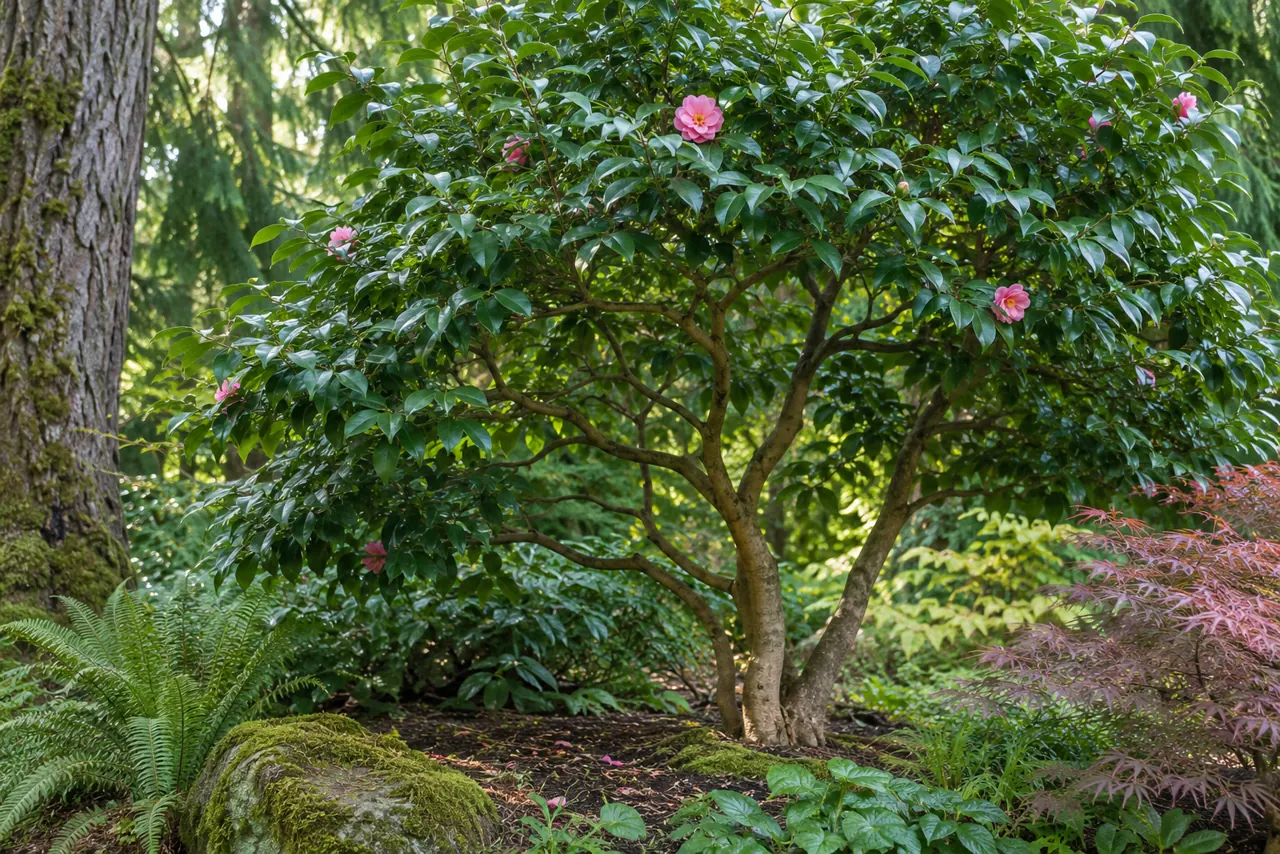
An old camellia can hide beautiful structure behind a solid wall of leaves. Architectural pruning is the selective process of revealing some of that structure without turning the plant into a collection of bare stems.
The finished plant should still look like a camellia. The goal is to create depth, movement, and intentional openings while retaining foliage where it supports health, flowering, and visual balance.
Choose the view that matters
Walk around the plant before deciding what to remove. A branch that blocks one view may create the best line from another. Identify the trunks or major branches worth revealing and the background that will be visible through each opening.
Good openings are rarely distributed evenly. Repeating the same gap around the plant can make it look manufactured. A few purposeful windows usually create more depth than general thinning.
Work from structure toward foliage
Begin by identifying dead, broken, crossing, or poorly placed stems. Then follow each candidate branch back to its origin and picture the space its removal would create. Keep branches that provide taper, movement, flowering wood, or useful foliage around the chosen framework.
Removing only the leaves and small twigs from a branch can leave an awkward bare stick. Removing the entire branch may create too much empty space. Architectural pruning often depends on finding the branch or lateral that preserves a believable transition.
Do not expose everything at once
Interior bark and foliage that developed in shade can be sensitive when suddenly exposed to stronger sun and heat. Heavy pruning also reduces the leaf area available to support roots and new growth.
For an overgrown specimen, a staged approach may be better. The first visit establishes the main lines and removes obvious conflicts. Later work responds to new growth and refines the form after the plant has adjusted.
Flowering changes the timing
Camellias form flower buds ahead of bloom. Pruning after flowering generally preserves more of the next display than removing budded growth beforehand. The exact timing and response vary with the type of camellia, weather, and the amount of work required.
If structure is the main objective, some flower loss may be an accepted tradeoff. That choice should be made deliberately rather than discovered after the cuts are finished.
Judge more than the outline
After pruning, look at how foliage is distributed around the retained structure. The plant should still have enough leaf density to support itself and avoid looking skeletal. Review new growth, flowering, stem exposure, and whether the openings still work from the intended viewpoint.
If an established camellia has appealing trunks but feels heavy or shapeless, an appointment can determine whether its structure supports architectural pruning and whether the change should be completed in one visit or developed gradually.
Reference: Washington State University, Pruning Woody Landscape Plants.