
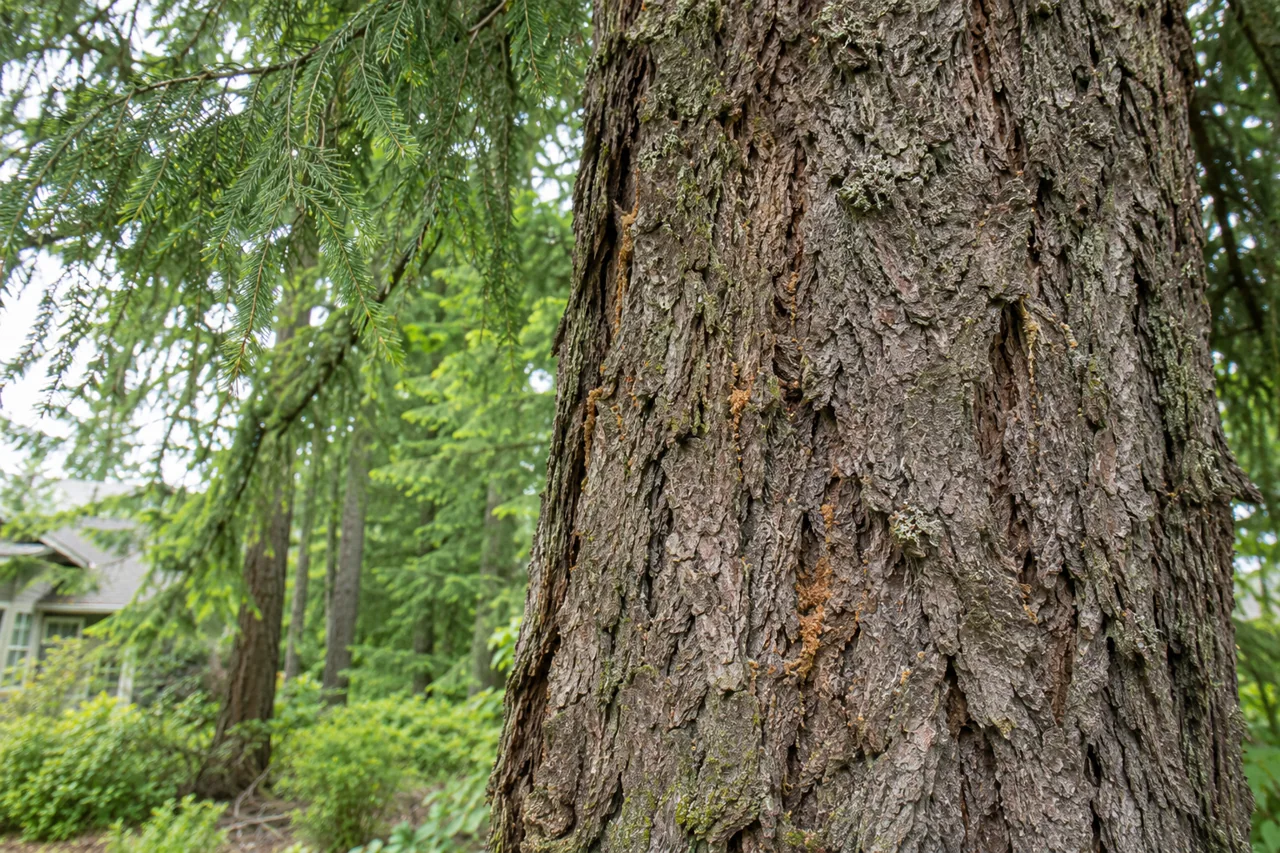
A Douglas-fir can look green and substantial while beetles are already working beneath its bark. By the time the entire crown turns red, the most useful treatment window may have passed. The better time to ask questions is when the signs are new, limited, or appearing in nearby trees.
Drought is an important part of this story. Douglas-fir evolved with bark beetles, but a tree under prolonged water stress has fewer resources for growth and defense. It may produce less resin, respond more slowly to attack, and have less capacity to contain injury. Several dry seasons, root damage, compaction, or disease can create stress even when the tree still looks fairly normal from a distance.
Start with what changed
Do not rely on one hole or one patch of sap. Look for a group of clues and compare them with the tree’s recent history:
- Fine reddish or tan boring material caught in bark crevices or at the trunk base
- New resin or pitch at entry points
- Woodpecker activity concentrated on the trunk
- Bark beginning to loosen or flake in an unusual pattern
- Foliage that is thinning, fading, or changing color outside its normal seasonal cycle
- Other Douglas-firs nearby that have recently declined or died
Fresh boring material is often more useful than an old exit hole. An exit hole confirms that an insect emerged from that location at some point. It does not tell you whether the tree is under active attack today or whether the same insect caused the current crown symptoms.
Why resin matters
Resin is part of a conifer’s defense. When a beetle attempts to enter, a well-hydrated tree may push resin into the wound and sometimes force the insect back out. Clear or light-colored resin can be evidence that the tree is responding. It is not proof that the attack has failed.
A dry or root-compromised tree may not produce the same response. Successful beetles create galleries beneath the bark, where feeding interrupts living tissues that move sugars and produce new vascular growth. Bark-beetle systems may also involve fungi that contribute to the loss of water movement.
Not every declining Douglas-fir has bark beetles
Drought injury, root disease, construction damage, soil compaction, grade changes, saturated roots, and other insects can produce overlapping symptoms. A tree may also have more than one problem. Root disease or drought may weaken it first, followed by beetle activity that accelerates decline.
Pattern helps separate those possibilities. A sudden change on one side of the crown may point toward a localized root or vascular problem. Several trees declining along a drainage path may lead toward roots and soil. Boring material and fresh attacks on the trunk add stronger support for beetle involvement. Removing bark from a living tree to look for galleries creates another wound and is not a good homeowner diagnostic method.
Why early protection has an advantage
Systemic injection can place a researched insecticidal active ingredient into functioning vascular tissue. The tree distributes it internally to areas where susceptible bark beetles feed. Arborjet TREE-äge formulations use emamectin benzoate, the most extensively studied systemic active ingredient for protecting western conifers from bark beetles. Current TREE-äge R10 labeling provides about two years of control for listed uses.
Preventive treatment gives the material time to move before galleries have interrupted large portions of the tree’s transport system. An injection cannot rebuild tissue that has already been girdled. This is why a valuable Douglas-fir near recent beetle activity may deserve attention while its crown is still functional, rather than after the entire tree has faded.
Protection should include the root zone
Controlling beetle pressure does not remove the conditions that left a tree vulnerable. Our programs pair internal protection with soil amendments, moisture management, and root-zone support selected for the property. The injection addresses the insect. The soil work supports water uptake, nutrient availability, root function, and the tree’s ability to produce its own defenses.
This does not mean applying the same blend everywhere. A compacted irrigated lawn, a dry slope, a recently disturbed construction site, and a naturally forested property do not need the same response. The plan should match the reason the tree is stressed.
When to have the tree checked
Fresh boring material, new trunk resin, concentrated woodpecker activity, crown fading, or nearby Douglas-fir mortality are all reasonable reasons to request an appointment. You do not need to identify the beetle first. The goal is to determine whether the pattern supports active bark-beetle pressure, whether the tree can still distribute treatment, and what soil or water conditions should be addressed at the same time.
References: Oregon State University Extension, Managing Insects and Diseases of Oregon Conifers; USDA Forest Service, Field Guide to Common Diseases and Insect Pests of Oregon and Washington Conifers; Oregon State University Extension, How Drought Stress Affects Landscape Trees; USDA Forest Service, Protecting Conifers from Bark Beetles With Insecticides in the Western United States.