
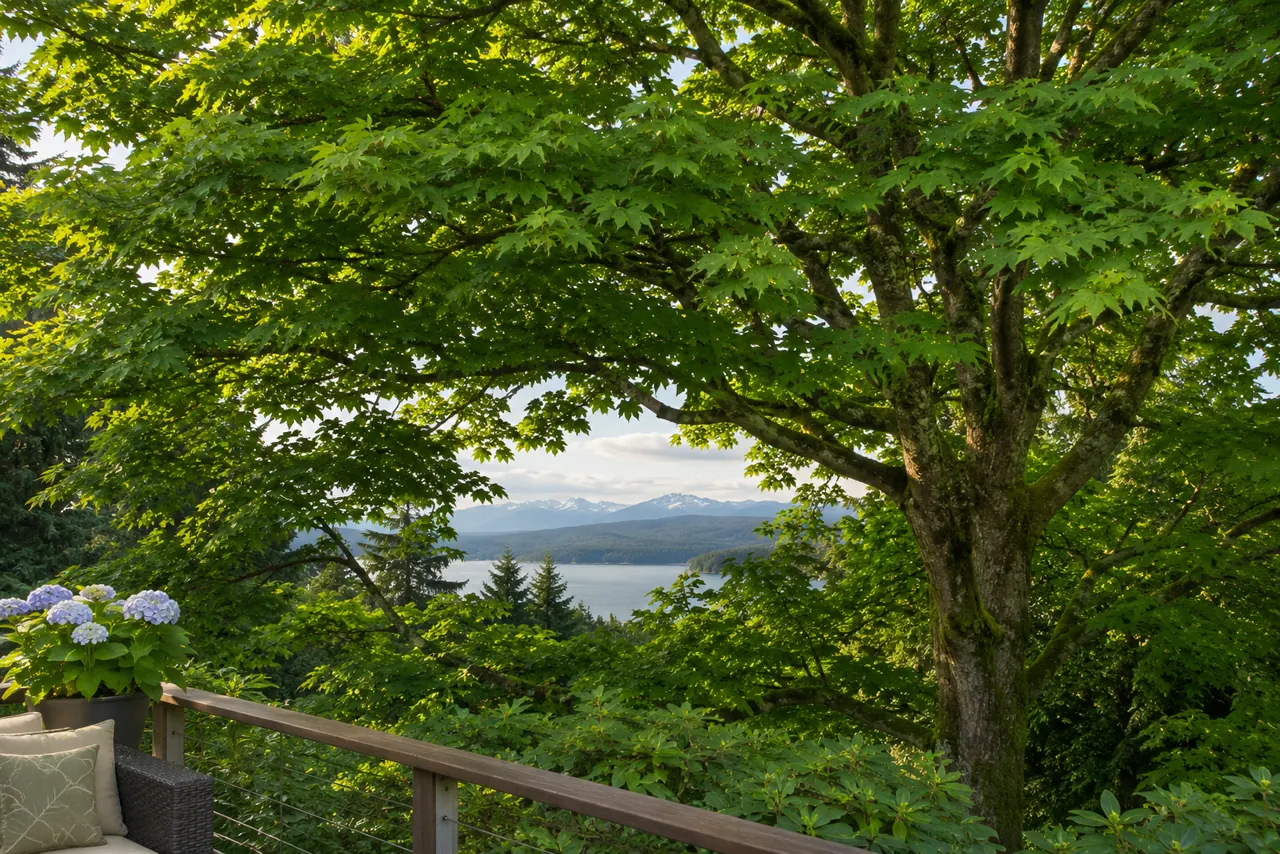
A useful view-pruning plan does not begin with “take the top off.” It begins by standing where the view matters and identifying the smallest part of the crown that actually blocks it.
That distinction changes the work. A broad height-reduction request can lead to large wounds, excessive foliage loss, rapid sprouting, and a tree that needs repeated correction. A defined sight line may be improved with a limited number of well-placed cuts while much of the crown remains intact.
Define the view before discussing cuts
A view is not one thing. It may be a seated view from a kitchen, a standing view from a deck, a narrow look toward water, or a wider opening across several trees. Mark the important viewing position and the feature that should remain visible. Then notice how the desired line changes as you move through the room or property.
This is where an advanced pruning objective becomes measurable. Instead of “make the tree smaller,” the objective might be “create a narrow window between these two scaffold limbs while retaining screening below and shade above.” A precise objective helps prevent the crown from being opened more than the view requires.
A window is different from a flat-topped crown
Topping cuts large branches between natural branch unions and leaves stubs that the tree cannot close in the same way as a correctly located pruning cut. The remaining tree often responds with dense shoots near the wounds. Those shoots can grow quickly, alter crown structure, and recreate the obstruction while adding future maintenance.
Selective view pruning relies more often on reduction cuts and removal cuts. A reduction cut shortens a branch back to a suitable lateral branch that can continue its growth. A removal cut takes a branch back to its point of origin without cutting through the branch collar. The choice depends on the objective, species, branch size, tree condition, and the structure that will remain.
The goal is not to hide cuts. It is to avoid asking the tree to close unnecessarily large wounds or replace a large amount of lost foliage at once.
Live-crown removal has a biological cost
Leaves and needles produce the carbohydrates used for growth, defense, storage, and wound response. Removing live crown changes that energy system. There is no single percentage that is safe for every tree. Young vigorous trees, mature trees, recently transplanted trees, drought-stressed trees, and declining trees do not have the same tolerance.
Professional guidance favors removing the least amount of living tissue needed to achieve the objective. When a view requires substantial change, several modest pruning cycles may be more defensible than one severe cut. The interval should be based on the tree’s response, not an automatic annual schedule.
The remaining branch structure matters
Each proposed cut changes loading and exposure elsewhere in the crown. Removing several branches from one side can create an unbalanced appearance, expose previously shaded bark and foliage to intense sun, or increase wind movement through and around the remaining branches. Lion-tailing, which strips interior branches and leaves foliage concentrated at branch ends, is not a sound way to create a view corridor.
A good plan considers branch attachment, taper, existing defects, decay, previous cuts, crown density, and the direction in which remaining branches can continue growing. A lateral branch used for reduction should be capable of assuming the terminal role. If no suitable lateral exists near the desired endpoint, the requested reduction may not be compatible with good pruning.
Species and site change the answer
Some trees produce vigorous sprouts after heavy pruning. Others have limited ability to generate new growth from old wood. Conifers, broadleaf evergreens, and deciduous trees can respond very differently to the same visual request. Tree age, vigor, drought history, root condition, exposure, and the time of year also affect tolerance.
The surrounding site matters too. A tree may provide screening, slope stability, wildlife habitat, summer shade, or protection from wind even when the immediate goal is a view. Neighboring trees and property ownership may limit which branches can be considered. Permission should be clear before work is planned on a tree that is not solely owned by the person requesting the view.
Plan for regrowth from the beginning
View pruning is rarely permanent. Branches continue to extend, foliage fills space, and the importance of the view may change. A durable plan anticipates where regrowth is likely, which branches can be reduced again without creating progressively larger wounds, and how the crown will look from more than one direction.
Photographs from the viewing point help define the original objective and compare results over time. The next review should ask whether the window still works, how the tree responded, and whether any new work is actually necessary.
When the requested view and the tree do not fit
Sometimes the desired opening would require removal of too much crown, repeated large cuts, or work that conflicts with the tree’s structure and health. In that situation, the honest options may be a smaller window, a different viewing angle, acceptance of seasonal obstruction, or a longer-term landscape decision. Topping is not a durable compromise.
If you can show the exact view you want to improve, an appointment can translate that sight line into a pruning objective and determine whether the tree can accommodate it without sacrificing the structure you will depend on later.
References: Washington State University, Pruning Woody Landscape Plants; International Society of Arboriculture, Best Management Practices: Pruning; International Society of Arboriculture, Mature Tree Care.