
A plant can wilt while standing in wet soil. The leaves are short of water, but the problem may begin with roots that cannot function in a saturated, oxygen-poor environment.
That situation can occur without an infectious disease. It can also create conditions that favor Phytophthora, a group of water molds capable of causing root and crown rot. The two problems often overlap, which is why appearance alone does not settle the diagnosis.
What poor drainage does to roots
Roots require oxygen for normal respiration. When pore spaces remain filled with water, fine roots can lose function and die. The top of the plant may respond with reduced growth, small or yellow leaves, wilting, early leaf drop, thinning, and branch dieback.
Low areas, compacted soil, frequent irrigation, downspout discharge, buried root flares, and planting holes surrounded by heavier soil can all keep a root zone wet. A root ball can also stay dry while water moves around it, so checking one damp spot at the surface is not enough.
Where Phytophthora enters the picture
Phytophthora produces structures that move readily in water and wet soil. Susceptibility varies by plant and by pathogen species. Infection may kill fine roots, move into larger roots, or reach the root collar. Diseased tissue beneath the bark can develop a distinct brown discoloration, but cutting into a living plant to look for it can damage the plant and compromise later sampling.
A wet site raises concern. It does not prove that Phytophthora is present. Drought followed by overwatering, construction injury, girdling roots, other root diseases, and vascular problems can create similar crown symptoms.
A regional tree that deserves special attention
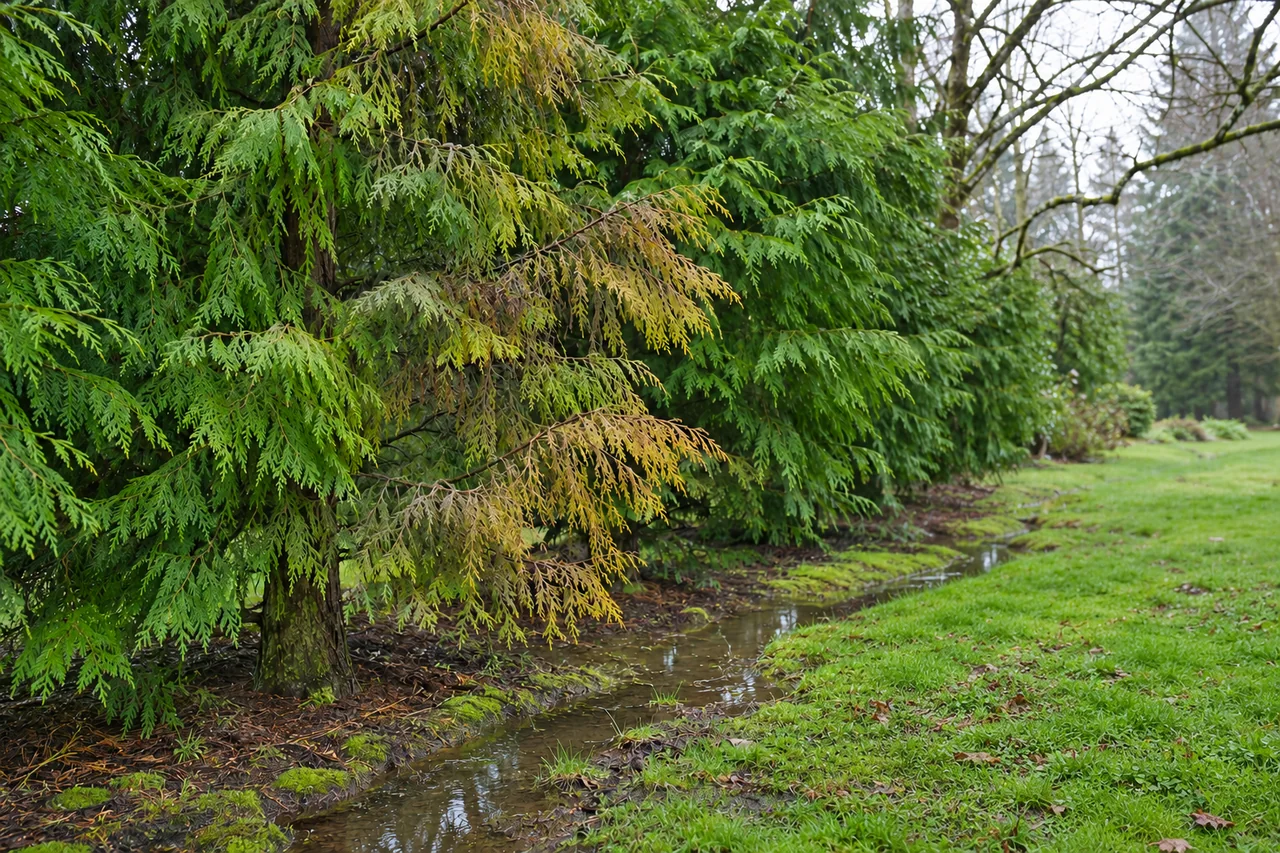
Port-Orford-cedar is highly susceptible to Phytophthora lateralis. Foliage may become pale, then yellow or bronze, while infection progresses from fine roots toward larger roots and the root collar. In rows or hedges, losses may follow water movement as contaminated soil or water carries the pathogen.
That recognizable pattern is useful, but diagnosis still matters. Port-Orford-cedar can also decline from drought, planting problems, other root diseases, and construction damage.
Prevention is more dependable than rescue
Protecting healthy roots before extensive infection is more reliable than trying to restore a plant after much of the root system has died. This is especially important for susceptible plants in wet sites or before a prolonged rainy period.
Prevention begins with drainage, irrigation that does not keep the root collar wet, suitable planting depth, clean planting material, and care that avoids moving contaminated soil or water into unaffected areas. A treatment product cannot replace those conditions.
When treatment may be part of the plan
Phosphite or phosphonate active ingredients are used in preventive and early disease-management programs for certain Phytophthora problems. They are not ordinary phosphorus fertilizer. Their use depends on the host, target, delivery method, timing, and current label.
Our treatment approach may also include soil amendments and root-zone support where those tools address moisture movement, soil structure, nutrient availability, or root conditions. Each ingredient has a separate purpose. The program should support the tree and reduce favorable disease conditions rather than relying on one material to solve every part of the problem.
Laboratory testing should change a decision
Testing is most useful when confirmation would change treatment, sanitation, removal, or replanting choices. A good sample comes from the advancing edge between healthy and affected tissue and follows the receiving laboratory’s instructions. A random piece of badly decayed root is less likely to answer the question.
A positive result still needs context because detecting an organism does not prove it explains every symptom. A negative result can occur when the submitted tissue did not contain a detectable part of the pathogen.
Measure the response
Useful follow-up may include new shoot growth, progression of dieback, crown density, moisture patterns after irrigation, and the condition of a defined lesion or root-collar area. Recovery takes time, and damaged roots do not reappear simply because foliage looks temporarily better.
When to request an appointment
Wilting in wet soil, yellowing in a susceptible plant, decline following drainage changes, repeated root-collar lesions, or several plants failing along the same water path deserve an on-site look. An appointment can determine whether the evidence points mainly toward water management, whether laboratory testing would be useful, and whether preventive treatment has a reasonable role.
References: Pacific Northwest Plant Disease Management Handbook, Port-Orford-cedar Root Rot; Washington State University, Plant Problem Diagnosis; Washington State University, Plant Pathology; Pacific Northwest Plant Disease Management Handbook, Phosphorous Acid.