
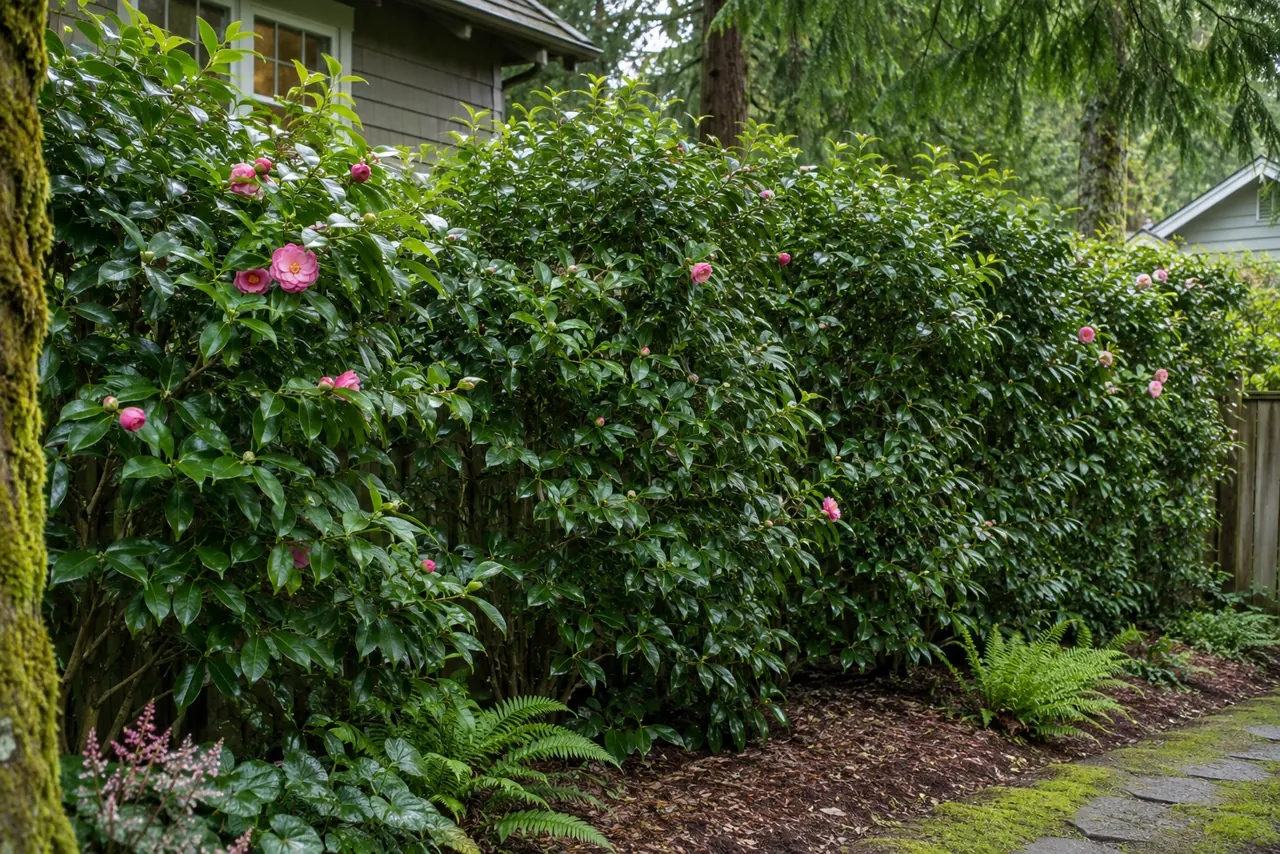
A camellia used for privacy has a job. Its flowers matter, but so does the living screen it provides at the height of a window, patio, walkway, or neighboring view.
That objective calls for a different pruning strategy than an architectural specimen. Revealing trunks and opening the interior may be beautiful on one plant and a failure on a hedge whose purpose is coverage.
Stand where privacy matters
Look through the screen from both sides and mark the exact gaps that matter. Coverage needed at seated height may be different from coverage needed at a standing window. Work from those sight lines instead of shaping only from the outside of the shrub.
Protect the lower foliage
Once useful low branches are removed, the gap may not fill quickly or at all. Avoid automatically lifting the canopy or cleaning every interior shoot. Some growth that appears untidy from close range may be doing important screening work from the house or patio.
Light is also important. If the upper portion becomes much wider and denser than the base, lower foliage can thin in shade. Managing the top and outer surface gradually can help retain light where coverage is needed.
Reduce growth without hollowing the plant
Shearing only the outer surface can create a dense shell with weak interior foliage. When that shell is eventually cut back, the brown interior becomes visible. Selective reduction to suitable laterals can manage extension while leaving foliage at different depths.
The goal is not to make every plant identical. It is to keep a continuous screen with enough variation and living depth to respond well.
Plan around flowers and new growth
Pruning after flowering usually protects more of the next season’s buds. Light corrections made regularly are less disruptive than waiting until the screen is far beyond its intended boundary.
A stressed or recently transplanted camellia may tolerate less live-foliage removal. Drought, root problems, poor drainage, and heavy shade should be addressed rather than asking pruning to correct the resulting thin growth.
Review the screen from a distance
Step back to the original viewing point before making more cuts. Small openings can look much larger from inside a room. Stop when the privacy objective is met, even if the outer surface is not perfectly uniform.
If a camellia screen is becoming too tall, bare below, or dense only at the surface, an appointment can define which foliage must remain and whether gradual reduction can restore a manageable outline without sacrificing coverage.
Reference: Washington State University, Pruning Woody Landscape Plants.