
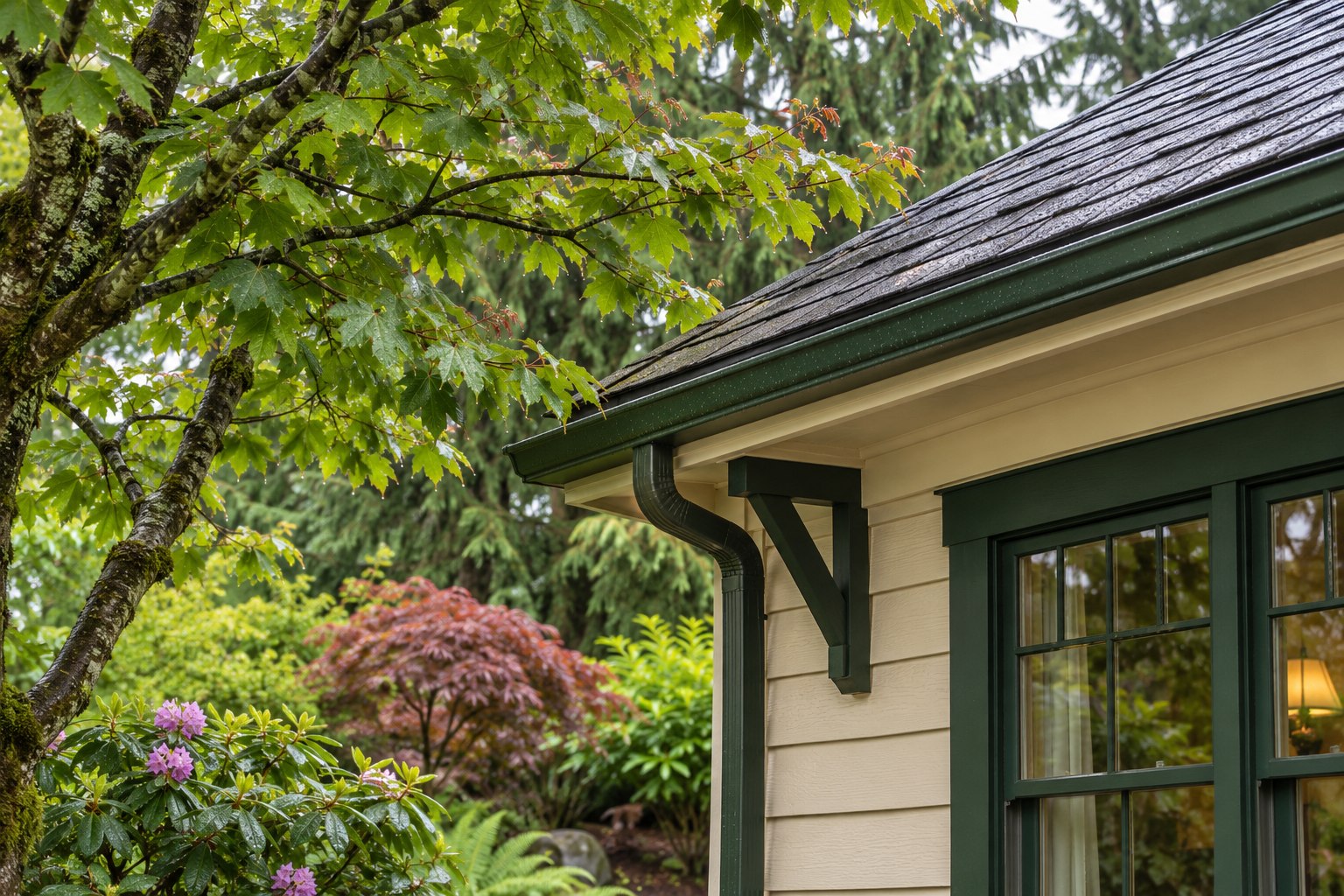
When the tree’s structure allows it, roughly 3 to 5 feet of separation from the house is a useful working target. If that distance cannot be reached without large or damaging cuts, create as much clearance as practical, prevent direct contact, and plan to revisit the tree as it grows. The goal is not to carve a large empty box around the house. Useful clearance also leaves room to inspect and maintain the roof while keeping the tree balanced and healthy.
There is no single clearance distance that fits every tree and every building. A fast-growing branch beside a gutter needs room for future growth. A heavy limb that moves several feet in wind deserves a different discussion than fine twigs near a wall. Roof material, tree species, branch size, slope, access, and the location of suitable pruning points all affect the plan.
Start with the conflict you are trying to prevent
Branches should not scrape roofing, siding, windows, gutters, or chimneys. Repeated movement can wear surfaces and damage twigs or bark. Dense growth over a roof can also make inspection, gutter cleaning, moss management, and repairs harder.
Clearance can be one part of rodent prevention. King County Public Health recommends keeping bushes, vines, and tree branches at least 3 feet from a house because roof rats can use overhanging branches to reach a roof. More separation can be helpful when it can be achieved without poor pruning. Pruning alone does not make a house rodent-proof, however. Roof rats and other animals may also climb rough surfaces, pipes, wires, and nearby structures. Sealing openings and reducing shelter and food around the building remain important.
Why 3 to 5 feet is a target, not a promise
A branch does not stop growing after it is pruned. The useful clearance is the distance that remains adequate through a reasonable maintenance cycle, not just the space visible on the day of the work. The branch may also rise, sag, or sway as foliage, rain, fruit, or snow changes its load. In some trees, the best result is less than 3 feet at first, followed by smaller adjustments over time. In others, 5 feet or more can be created with modest, well-placed cuts.
Species matter too. Some trees produce vigorous regrowth after hard reduction. Others tolerate only modest pruning. Cutting a large limb merely to reach an arbitrary distance may create a wound and remove more live crown than the situation warrants.
How clearance can be created without stripping the tree
Whenever possible, a branch is shortened to a suitable lateral branch that can continue its growth. This is called a reduction cut. It is different from leaving a stub or cutting the branch at a random point. Selective reduction can pull the canopy away from a structure while retaining natural form.
Removing every branch on the house side can shift the visual and mechanical balance of the crown. It can also expose previously shaded bark and interior foliage to more sun and wind. The better plan may combine a few reductions, removal of dead or broken branches, and a scheduled recheck.
Questions worth answering before the work
- Are branches touching the building now, or are they simply visible above it?
- Which parts move toward the roof in wind or under seasonal weight?
- Can the conflict be solved with small cuts at appropriate branch unions?
- Will the proposed work preserve a reasonable amount of live crown?
- Is the concern maintenance access, roof wear, rodents, storm exposure, or a combination?
Photographs from the ground can document the conflict, but do not climb onto a wet roof or place a ladder into the canopy to investigate. Branches near service lines or other electrical conductors require the utility or a properly qualified line-clearance professional.
Clearance is a maintenance decision, not a one-time promise
Some trees may hold useful clearance for years. Others need lighter, more frequent attention. A good recommendation explains what will be cut, why those branches were selected, and when the relationship between tree and building should be reviewed again.
If the canopy is already touching the house or the correct pruning points are not obvious, request an appointment. We can look at the tree, the building, and the objective together before recommending how much clearance makes sense.
Sources: Washington State University, Reasons to Prune Trees and Shrubs; King County Public Health, Preventing Rodents and Keeping Them Away; International Society of Arboriculture, Pruning Your Trees.