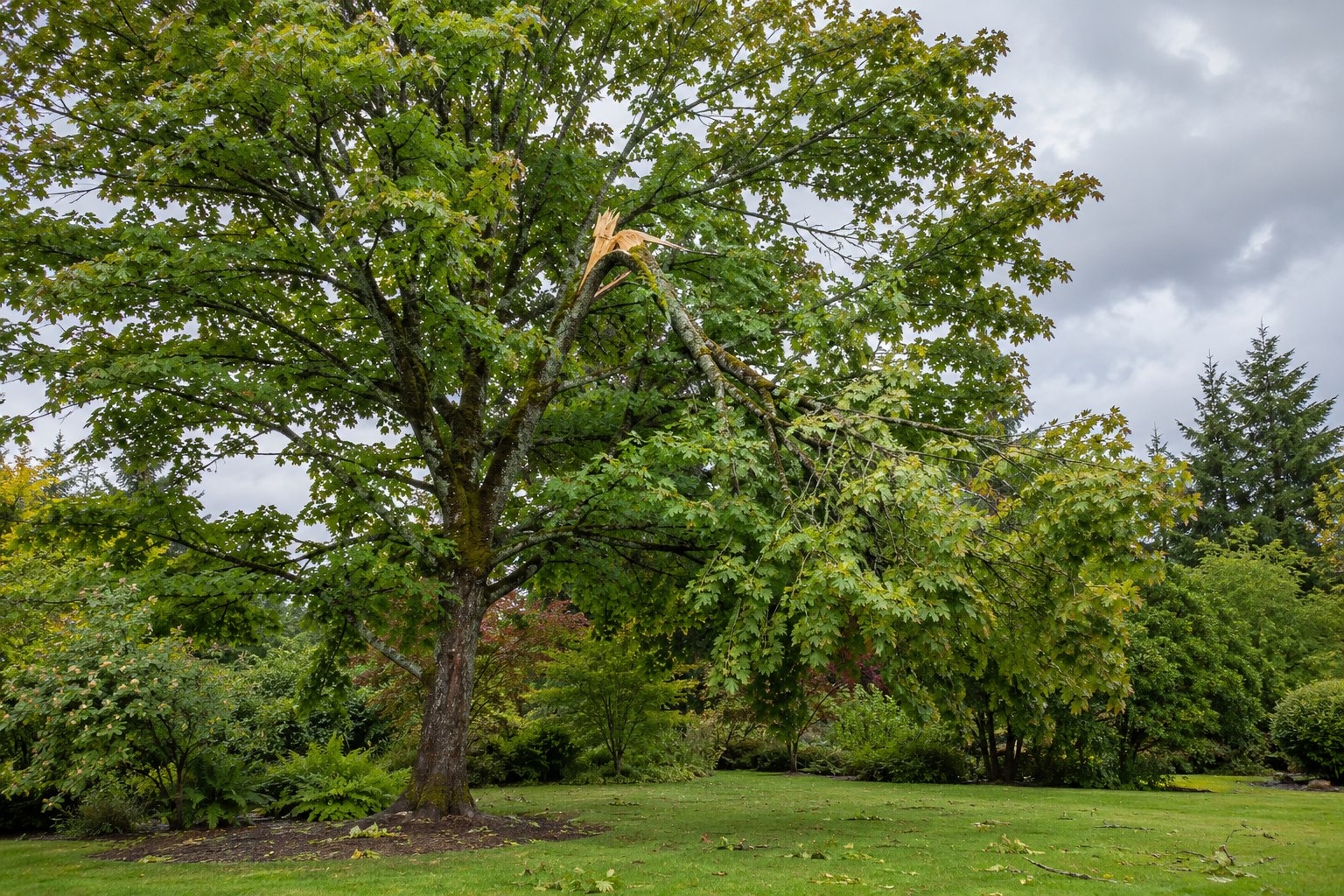
A broken top can make a tree look finished even when much of its living crown remains. Another tree may keep its green leaves after a break but have a split that changes the structural outlook completely. The size of the missing piece is only one part of the decision.
The first question after a storm is safety. Stay away from hanging limbs, split trunks, uprooted roots, and any tree contacting a utility line. Do not stand beneath the damage to photograph it. When immediate hazards are controlled, the tree can be judged more carefully.
What recovery actually means
Trees do not replace damaged wood the way people heal a broken bone. They grow new wood around injuries and reorganize the crown that remains. A surviving tree may continue to live and become functional again, but the old break remains part of its structure.
Recovery may mean preserving a shade tree with a smaller crown, guiding new branches over several pruning cycles, or simply monitoring a tree that has enough sound structure left. It does not always mean recreating the tree’s former shape.
Signs that support a closer look at preservation
- A substantial portion of the healthy crown remains.
- The trunk below the break is not split or visibly twisted.
- The root plate has not lifted or shifted.
- Remaining major branches have sound attachments and useful positions.
- The broken part can be removed without stripping most of the live crown.
- The tree has enough space and time for corrective growth.
Young trees often have more options for structural correction than mature trees. Species, age, vitality, previous pruning, decay, drought stress, and the location of the break all influence the response.
Damage that changes the conversation
A crack continuing down the main trunk is more consequential than a cleanly broken side branch. So are exposed or lifted roots, a newly changed lean, multiple failed leaders, internal decay at the break, or a major wound that removes a large share of the trunk circumference.
The surroundings matter as much as the defect. A damaged branch over an unused part of a garden presents a different potential consequence than the same branch over a bedroom, driveway, play area, or sidewalk. Tree risk is considered in relation to what could be struck and how the site is used, not from the appearance of the break alone.
What happens after the broken material is removed
The remaining tree may produce vigorous new shoots near the injury. That growth can help rebuild leaf area, but a cluster of shoots should not automatically be treated as a finished replacement top. Over time, selected growth may be guided while poorly placed or competing shoots are managed.
Avoid topping the rest of the tree to make it look even. Additional heading cuts remove more foliage and create more wounds at the moment the tree needs functional leaf area. Corrective work is usually more selective and may be spread across several years.
Monitor the tree, not just the wound
Photograph the tree from the same safe locations after the damage and during future growing seasons. Watch for a changing lean, widening cracks, new decay, dieback, unusually sparse foliage, or additional branch failures. Also note construction, excavation, irrigation changes, and drought conditions around the root area.
A retained tree may need a shorter inspection interval after major damage. That is not a sign that preservation was the wrong choice. It is part of managing a tree whose structure and exposure have changed.
The answer should fit this tree and this site
Some damaged trees recover well enough to remain valuable for decades. Others have lost the parts that made continued retention reasonable. The sound decision comes from the remaining crown, the break, the trunk and roots, the targets, and the owner’s objectives taken together.
If a large top or branch has failed and you are unsure what can be retained, request an appointment. An assessment can help separate urgent work from corrective pruning and longer-term monitoring.
Sources: International Society of Arboriculture, Managing Hazards and Risk and Safe Response to Storm Damage; International Society of Arboriculture, Post-Storm Tree Debris Cleanup; Washington State University, Reasons to Prune Trees and Shrubs.