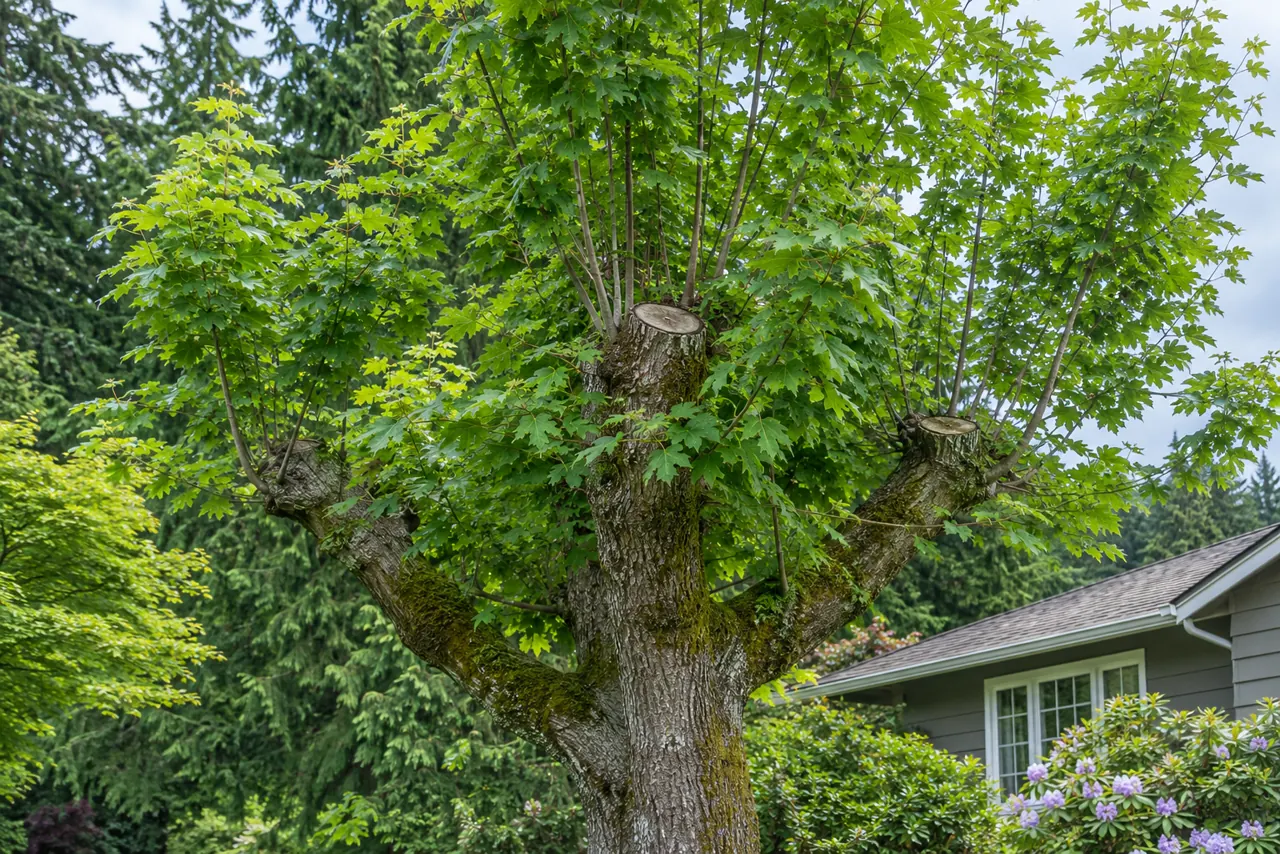
A topped tree has been severely and improperly pruned. That statement is straightforward. Deciding whether the tree presents an unacceptable risk is a separate question.
Topping creates conditions that can increase future failure potential, but the cut alone does not tell us which part will fail, whether it will strike anything, or how soon that might happen.
What topping does to a tree
Topping removes branches between suitable unions and leaves large stubs or undersized laterals. It can remove a major portion of the leaf-bearing crown, reducing the tree’s ability to produce energy. Large exposed wounds may close slowly or not at all, allowing decay to develop behind the cut.
The remaining branches and trunk may also be exposed to sunlight they did not previously receive, increasing the possibility of bark injury.
Why the new shoots are different
A topped tree often responds by producing many fast-growing shoots near the cuts. That quick growth can make the tree look recovered, but the new shoots originate around injured and potentially decaying tissue. Their attachment and the condition of the supporting branch matter as they become larger and heavier.
Repeated topping creates a cycle. New shoots restore height, the tree is cut back again, wounds become larger or more numerous, and the supporting structure continues to change.
A defect is not the entire risk assessment
Tree risk considers the likelihood that a specific part will fail, the likelihood that it will strike a person or object, and the consequences if it does. The time period matters too.
A topped tree beside a frequently occupied house is not the same situation as a similar tree in an area where people and property are rarely present. Sprout size, attachment, decay, species response, wind exposure, previous failures, and the condition of the roots and trunk all change the assessment.
What can be checked from the ground
Look for cavities or decay beneath old cuts, cracks, hanging branches, fungal fruiting bodies, dead sprouts, changes in lean, lifting soil, and branches extending over occupied areas. These observations can identify a reason for further assessment. They cannot confirm that the tree is safe.
Keep people away and seek prompt help when a branch is actively hanging, a crack is changing, the tree has shifted, soil is lifting, or electrical conductors are involved.
Possible paths forward
Some topped trees can be managed through selective restoration pruning. That usually means choosing better-positioned sprouts, reducing competition over time, and monitoring the old cuts and supporting wood. It is not an instant return to the tree’s original structure.
Other trees may need targeted risk reduction, changes to the area beneath them, continued monitoring, or removal. The best choice depends on condition, expected benefit, remaining life, targets, and the owner’s tolerance for ongoing care.
If a tree has been topped, an appointment can determine which defects are present, what could be struck, and whether restoration, risk reduction, monitoring, or replacement is the most reasonable next step.
References: International Society of Arboriculture, Pruning Trees and Why Topping Hurts Trees; ISA, Why Topping Hurts Trees; ISA, Managing Hazards and Risk.